

The stone of the hummingbird: A journey through the historical heritage
A history of light, memory, and craftsmanship behind
Remy and Perez’s silver opal rings
At a time when luxury is often measured by the speed of a trend, there is another way to
understand it: to choose less, choose better, and know the story behind what one wears.
This is the principle of slow luxury. It is not simply about acquiring an exceptional piece. It is
about recognising the time held within it: the geological time of the stone, the time invested in craftsmanship, and the cultural time of a tradition that has valued gemstones long before modern categories of jewellery existed.
R&P’s Mexican opal silver rings belong to this conversation. Each piece brings together the
restraint of silver and a stone whose appearance shifts with light, angle, and movement. Yet
its appeal extends beyond the visual. For those drawn to jewellery with character, opal
offers a passage into Mexico’s history and into a more considered relationship with
precious objects.
Before the trend: stones as signs of valueul of Mexico
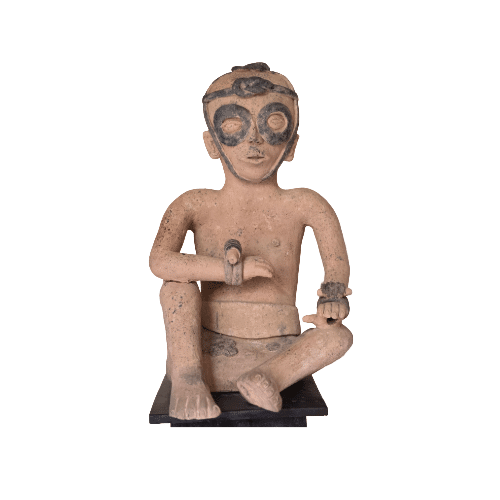
As early as the Olmec Preclassic period, Mesoamerican societies selected stones and materials for qualities that we now associate with gemological value: brilliance, rarity, hardness, and colour. Gemstones did not exist in isolation. They appeared in codices, ceramics, stone sculptures, and mural paintings, within a world where material, power, and the sacred were deeply intertwined.
Among the most highly valued materials were jade, gold, and silver. Their importance was not determined solely by scarcity or beauty. It was also connected to their ability to become symbols of authority, protection, continuity, and a relationship with the unseen.
Across different communities, jewellery served purposes that extended well beyond adornment. Among the Purépecha, for instance, rulers could pass their jewels on to their
successors as part of the transmission of power. In other contexts, a precious stone was
placed inside the mouth of someone who had died, with the intention of accompanying
their passage into the underworld.
These practices help us understand that, in ancient Mexico, a jewellery and a gemstone were not merely a beautiful object. They were materials charged with meaning. Their presence could speak of lineage, ritual, protection or belonging.
Opal within the lapidary tradition
By the time Iberian conquistadors arrived, the extraction and working of gemstones and
precious metals were already established practices. There were specialists who knew how
to recognise a stone, work it, and transform it into an object of value. Lapidary art—the
cutting, polishing, and shaping of stone—formed part of a sophisticated material culture.
In Historia general de las cosas de la Nueva España, Fray Bernardino de Sahagún recorded that lapidaries honoured four gods to whom they
attributed the knowledge and techniques required to work stone. Craftspeople held
celebrations in their honour, particularly in Xochimilco, which they identified as the
birthplace of their ancestors and their trade. His account suggests that transforming a stone
was understood not merely as a technical task, but also as a practice with a ritual and
communal dimension.
Within this vocabulary appears Huitzitzíltetl, “hummingbird stone”, a name associated
with opal. The image is telling. The hummingbird, linked to movement, energy, and the
vibration of colour, offers a way of naming a stone whose appearance seems to change as
light passes across it.
The word Teucalco, “in the house of the god”, also appears as the name of a place where
precious jewels and feathers were kept. More than a simple repository, the term suggests
the importance these objects could hold within a ceremonial order. Precious pieces were
safeguarded because they concentrated beauty, power, and meaning.
Tribute, prestige and the fascination with stones
In his account of the tributes received by the Mexica empire after war, Fray Diego Durán
describes a great variety of stones alongside gold, jewels, and feathers. His text reveals the
extent to which these materials were valued and how they could be woven into the
religious and political life of the time.
“A great quantity of gold, both in powder and in jewels; a great quantity of green stones
of jade, crystal stones, carnelian, bloodstones, amber stones, and a thousand kinds of
stones for which these people had a great affection. Thus, their principal idolatry was
always founded upon the worship of these stones together with the feathers, which they
called ‘the shadow of the gods.’”—Fray Diego Durán, History of the Indies of New
Spain and the Islands of the Mainland, chapter XXV. English translation from the original
Spanish.
Read from the present, this description should not be reduced to an idea of accumulation.
Stones formed part of systems of exchange, tribute, and representation. To possess them
expressed hierarchy, but also a relationship with the sacred and with collective memory.
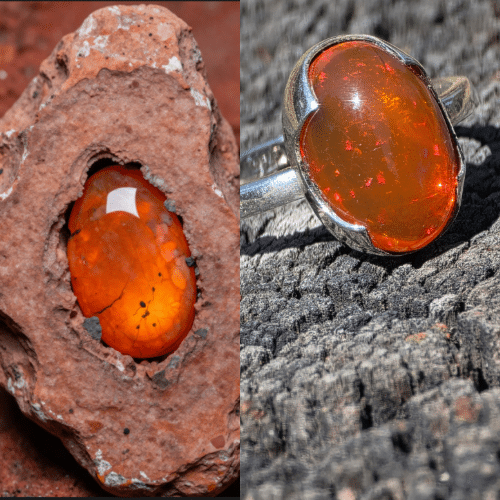
After the Spanish conquest, the secret of the fire opal remained hidden for centuries, known only to the local communities who lived near the volcanic highlands. It wasn’t until the 1870s, in the region of Queretaro, that these “sleeping fires” were rediscovered. Magdalena, Jalisco was another important spot of this wonderful of play of colors into the stones. Since then, Mexico has been recognised as the world’s premier source of this rare gem, captivating European high jewellery houses with its untamed beauty and vibrant spirit.
The Philosophy of Time: What it means to choose an opal ring today.
At Remy & Perez, we believe the opal is the ultimate expression of Slow Luxury. It takes millions of years for nature to craft a single gem. By choosing a fire opal, you are not just wearing a jewel; you are becoming the guardian of a fragment of time that can never be replicated.
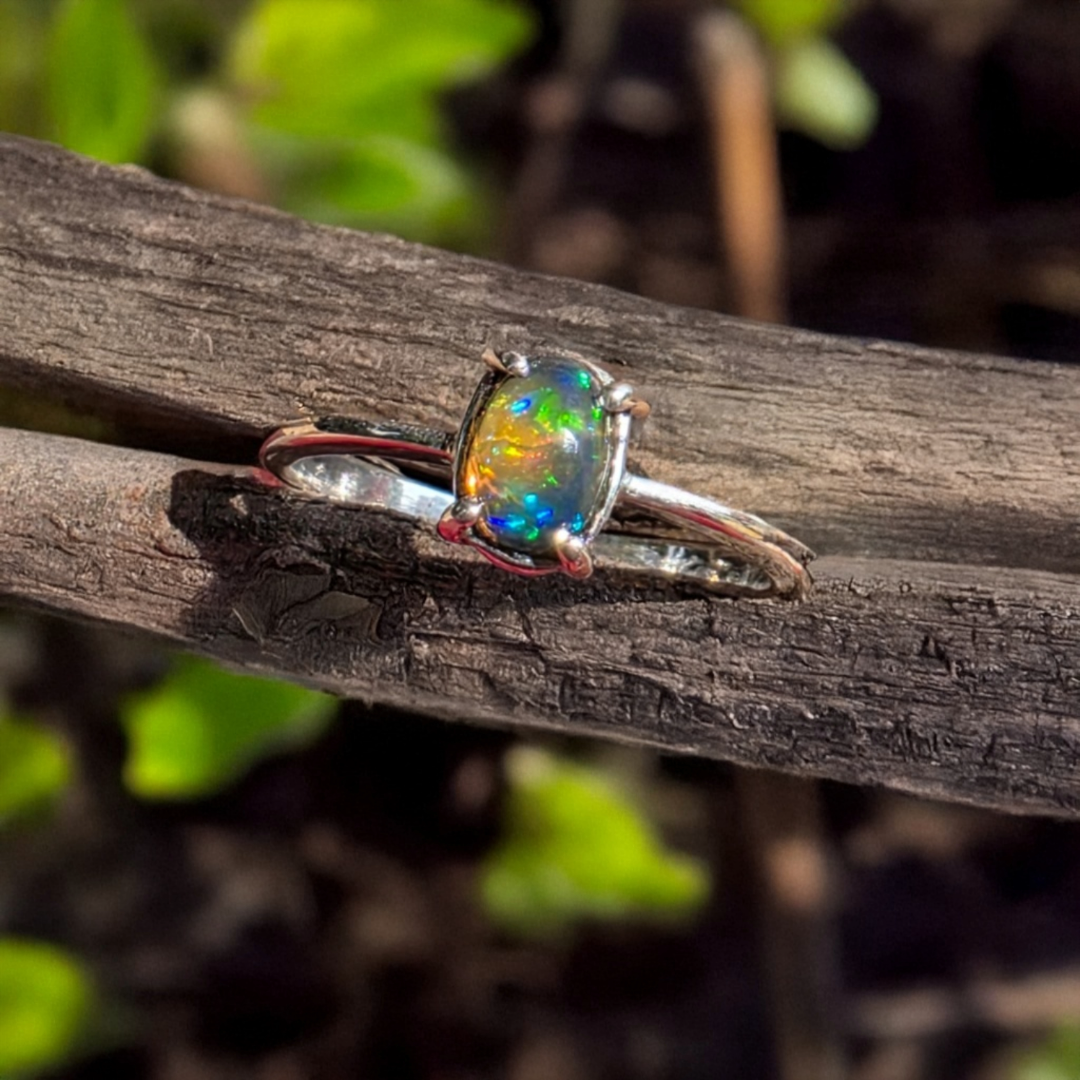
Opal does not offer a static visual surface. Its colour may reveal different nuances as the
light changes. The same stone may appear serene at one moment and vibrant at the next.
For this reason, every opal has a distinct presence: it is not only observed, but gradually
discovered over time.
Silver, in turn, provides a clean and timeless structure. Its brightness can contrast with the
depth of the opal without competing with it. The result is a piece of understated elegance,
suited to those who prefer personal expression to overt display.
From a slow luxury perspective, choosing such a ring means pausing over questions more
meaningful than season or trend: What story do I want to carry? What craft do I want to
honour? Which piece might accompany me for years? The answer is not found in the
most conspicuous object, but in the one with which a lasting relationship can be formed.
A stone associated with the hummingbird, with the movement of light, and with a Mexican tradition that has recognised for centuries that some forms of beauty are also forms of knowledge.